
Jack & Helen Frye Story – the Camelot Years of TWA
The Frye Legacy
A Lifetime of Accomplishment
TWA Executive Plane Lockheed Electra 12A Junior NC18137 #240
By Randall Reynolds
Brand New Website Which Visually Documents the Lives of Jack & Helen Frye
My purpose in creation of this website is to not repeat narrative found in my novel ‘the Jack and Helen Frye Story’ but rather provide readers with images and text to complement the book.

To purchase my Biography-Novel-Love Story please click: Jack & Helen Frye Story – the Camelot Years of TWA which is available on Amazon in Softcover or Kindle.
This page features extensive information as to Jack’s use of this Lockheed, the documentation is so comprehensive, I was not able to include such into my book narrative ‘Jack & Helen Frye Story – the Camelot Years of TWA‘. Page is best viewed on a P.C., Laptop, or Android, set to Desktop View.
The following page under development

Jack Frye (above) at his private airstrip (Cornville Road and 89A) near his Sedona Ranch.

In the fall of 1940 TWA President Jack Frye, heretofore seen crisscrossing the country in two different TWA Northrop Gammas, acquired a new (to TWA) executive plane, a 1937 Lockheed 12A (NC18137) previously owned by Continental Airlines (Denver). As seen (above) at a meeting of the Air Transport Association is Jack’s good friend Robert (Bob) Six (owner of Continental). TWA purchased the plane as an executive transport and experimental over-the-weather laboratory. Because of Frye’s use of the plane and his spearheading the TWA ‘overweather program’ from the early 1930’s the ship came to be heavily associated with Jack in newspapers, books, trade publications, and in the memories of associates. It was known as “Jack Frye’s private Lockheed” and if you saw it landing or taking off around the United States you could be assured Frye was out in the field conducting the business of Transcontinental & Western Air. This twin engine Electra over the next 5 years of TWA ownership became Frye’s favorite ‘in-the-air TWA office’, and stands as a rich and valuable aviation artifact. This said, the plane was a vital necessity for President Frye, as a matter of fact so often the engines would barely cool before he was lifting off for another TWA hub.

(Above) we view the Lockheed Electra shortly after TWA’s purchase of the plane (image captured by Russell Robinson) who served as Frye’s co-pilot (1942-1943). Shared with Sedona Legend by his daughter Dorothy Robinson Nylan who has provided a wealth of information regarding her father’s association with TWA and Frye’s private Lockheed 12A pilot. I will be forever grateful to her generosity.
In the words of Jack Frye:
“I fly a Lockheed 12 airplane in my work as President of Transcontinental & Western Air, Inc., and for a period of approximately one year Mr. Robinson flew with me as co-pilot. During this time, I had the opportunity to observe him closely and found him to be a very conscientious, efficient and hard-working young man. He is careful, conservative and thorough. On several occasions he flew the Lockheed 12 alone, landed on fields off our regular land, and had no trouble in handling the plane.”
Signed (signature)
Jack Frye, President
Transcontinental & Western, Air, Inc.

(Above) in a never before seen image purchased on Ebay is Jack’s Lockheed 12A NC18137. Please note the plane seen inside the TWA Burbank hangar being seviced by TWA ground crew. How do we know this is Jack’s 12A? Because of the ‘TWA’ fuselage identification, dual red stripes on the tail, and the three portals. This was the only Lockheed TWA Electra 12A TWA owned and there can be no mistaking the plane in this lost image. Remarkable find to be sure!
In His Own Words- a Year & an a 1/2 in the Life as Jack Frye’s L12 Pilot, TWA #240, NC18137
Dedicated to Transcontinental & Western Air, Inc. TWA Pilot Russell H. Robinson & his daughter Dorothy Robinson Nylen
The following information from Bob (seen below) is a remarkable overview of Frye’s flights in TWA Lockheed NC18137 which up to this point would be totally lost if not for his daughter. Thus said, much of the information on this page is dedicated to Transcontinental & Western Air, Inc. TWA Pilot (Robert) Russell H. Robinson & his daughter Dorothy Robinson Nylen. Narrative is transcribed unedited and may reflect typos, etc.
Back Story- Sedona Legend Editorial
The creation of the Frye web-presence has been a great adventure if not more than a little laborious at times. Every so often I am contacted by a person connected with the Frye legacy who has such an amazing contribution that I am absolutely bowled over. In this case- a story which was totally forgotten for some 60 years, offered by a lady whose father was one of Jack Frye’s private pilots on his famous Lockheed 12A. She had seen the Frye presence on the internet and wanted to share her father’s story. From 68-year-old letters I began to extract the story of an energetic 25-year-old old employee of Transcontinental & Western Air, Inc. who by incredible tenacity and talent became the private pilot for Jack Frye President of TWA. This story is presented below and entitled simply- “In His Own Words” as written in letters to his parents. Invaluable historical insights are revealed regarding Frye, TWA, and the complications of an ambitious young pilot working for an airline at the onset and duration of World War II. It must be noted that during this time-frame flight personnel at TWA were at a minimum. Not only was Executive Vice-President Paul Richter on leave from (1942 to 1946) leaving John A. Collings to fill his position, but there was a critical shortage of TWA pilots as well. This made it quite difficult at times for Jack Frye to assign a crew member to serve as co-pilot on his personal executive planes (TWA Lockheed 12 and TWA Lockheed 18). It may seem in reading the following excerpts from letters that Jack was bypassing TWA protocol, but the circumstances were more so that he was trying to utilize personnel not needed for scheduled Transcontinental & Western Air flight service and the war effort. Unfortunately the then TWA Pilot’s Union was less than cooperative in adhering to executive orders or understanding the complications of TWA operations during this uncharted period. It should be clarified that the 12A was an official corporate plane used for critical presidential business by Frye in the air multiple times a week in his management of TWA. The Lockheed was used privately for the most part only as Jack could coordinate business trips with in-transit personal trips. Few TWA associates realize Frye’s position with TWA was literally 24/7.
Original specifications of TWA’s 1937 Lockheed (L12) 12A, C/N 1229, NC18137, Lockheed configurations: 2 pilots and 6 passengers. Twin engine- (2) 450 H.P. Pratt and Whitney power plants, 200 Gallons fuel load. Cruise speed better than 200 m.p.h. (210 m.p.h. @ 7000 feet)
As notated by co-pilot Robby (Bob), the following details have been lost for over 70 years by all NC18137 owners. At the onset of TWA ownership Frye had the Electra retrofitted by either Lockheed Aircraft or TWA for extended flights. As related by Frye’s Co-Pilot Robinson, ‘First two passenger seats were removed- in this space, (2) auxiliary (48) gallon fuel tanks were mounted. Increased fuel load- 298-gallons- resulting in ‘a safe 6-hours of flight time.’ This made it possible for President Frye and passengers to fly non-stop from (Kansas City to Washington D.C.) and (Kansas City to Winslow Arizona) according to Robinson. This meant the Lockheed twin was able to fly from Kansas City to Winslow in the same time it took a DC-3 to reach Columbus Ohio. Passenger capacity was reduced from 6 to 4 (2-pilots and 4-passengers). Robinson further noted Jack’s L12 had a 1200-mile range @ 210 m.p.h. with 6 hrs. aloft. Technical notes and details documented in Robinson letters found in overview below. This heretofore lost information is a stunning discovery and solves the mystery of known passenger loads on various trips making this TWA 12A quite unique! According to Robinson (1942) the only Transcontinental & Western Air personnel qualified and officially trained to operate the Lockheed NC18137, were TWA President Jack Frye, TWA Captain W. R. “Bill” Hedenquist, TWA Division Chief Pilot Roby, and TWA Frye Co-Pilot Russell (Robby) Robinson. Please note: Paul Richter also flew the 12A (primarily at its onset with TWA) this information was not mentioned by Robinson but was likely unknown to him because Richter was serving with the military overseas (1942-1946) and was on leave from TWA while Robby was employed there.

Remarkably, ‘Robby’ Robert (Bob) Russell (shown above) took many color photos and slides of his trips with Jack and Helen Frye and has left us with this rare treasure (seen below). There is no other known color photograph of this plane from this period of TWA ownership (1942-43). We find in reviewing Robby’s TWA notes and family letters that the date of the photo is either (November 19th – November 24th, 1942) or an additional trip to Sedona (January 8th – January 13th, 1943). Image taken at Clemencea Airport (Cottonwood Arizona) the closest facility to the Frye Ranch where the plane could be fueled and serviced.

Frye’s Executive Plane NC18137 seen at Clemenceau Airfield (Cottonwood Arizona). Both images (color and black & white) were taken in 1942 (at the same timeframe) during a visit by the Fryes to their newly purchased Sedona Ranch. This visit, just one of many, were with co-pilot Robinson (who took the color image). The men shown in the black and white image were part of Jack’s involvement with the Arizona Civilian Pilot Training program (detailed in article following on this page October 24, 1941). To this end Jack had already purchased (or leased) the property at the junction of Cornville Road and 89 for use as a private landing strip to land his 12A, and later, the TWA Lockheed Lodestar 18. The event cited took place at this newly graded airstrip.

Identification of plane featured above, Lockheed (L12A) Junior, Electra, NC18137, NX18137, TWA Fleet Number 240, C/N 1229. Color image captured by TWA pilot Robby Robinson (1942) All Rights Reserved.

December 31, 1941
Dear Mom-
The story is this, I have passed the physical as I told Ted, (brother of Russell) and I start to work for TWA on the 5th of January, but before they will pay me for my time, I have to fulfill all of their requirements. That means that I have to have my instrument rating. They made arrangements with the operator to complete my time, at my expense of course…. I have a very nice apartment now. It costs me $35.00 per month with everything furnished but the food. The address in case you haven’t already got it, is “1004 Locust Street, Apt. 412, Kansas City, Missouri.” It is just one block from the YMCA. Happy New Year to all. Love, Bob

January 1, 1942
Dear Mrs. Robinson and Ted –
Before Bob left, we agreed that the most economical thing to do would be for me to wait until he had finished his training and he had been assigned a definite base. But, gee, I got five airmail letters and three telegrams telling me he was too lonesome to do things right and for me to come immediately – so I’m on my way- I expect he has written to you and told you his plans- but here’s what news I’ve received so far anyway-
- Passed physical examination (Really stiff) – declared in A1 condition. (weighed 180 lbs before he left)
- Completing practice on his instrument rating now – trying to get it finished by Jan. 5th.
- Then he starts training in the TWA school Jan 5th, instrument rating or no instrument rating, by that time his pay will start in full on that date, but if not his pay will start as soon as he obtains it.
- The training will last from 4 to 6 weeks – then he will be put on a run for 2 weeks – after which he’ll be assigned a base for 1 year- Signed, Lois

(Shown Above) TWA Pilot Robert (Bob) Robinson with his wife Lois. Notice the radio (left) where family members would gather around to listen to the dire updates on World War II, and no doubt President Roosevelt’s ‘Fireside Chat’.
January 7, 1942
Dear Dad- Perhaps this will help to enlighten you on my situation here. I was one of twelve men to take the entrance physical which lasted almost three and 1/2 hours (these twelve were selected from six hundred applicants). I was one of the four that passed the physical and one of the two that passed it without a reexamination. We started classes at nine, Monday the fifth, there are four in the class and we were told today that we are to be the last class for the duration of the war unless the government gives the airlines another bunch of new ships. As yet I have not completed my instrument rating the weather has been too cold to practice, as the ship is an open plane. TWA has made arrangements with some insurance company for their employees, which enables them for a small monthly payment, for us it would be about five or six dollars, to cover themselves and their families with life insurance, (1500.00 each) and also hospitalization and compensation at the rate of $25.00 per week while laid up. I talked to one fellow who had had an opportunity to use his and he said he would not be without it now. The Co. also paid him his regular wages while he was laid up. The more I become acquainted with this company the more I wonder why I even considered United at all.
April 15, 1942
Hilton Hotel, Albuquerque, N.M.
Dear Ted-
I am in Albuquerque, New Mexico, arrived here Monday at 7 AM, and as there has been a bunch of Captains out here, they keep bumping me off and taking return trips to K.C. May go back tonight if no one else comes along. Bob
October 2, 1942
Transcontinental & Western Air, Inc. National Airport, Washington, D.C.
Dear Mom, Dad, Peg & Ted-
Look where I am! Yes, Washington D.C. I came here as copilot to Jack Frye, President of T.W.A. I can better understand what you meant about Washington now Dad. What a “High jinking joint” this is. If it weren’t the Capital of parasites and procrastinators, it would be a very beautiful place. I have not been able to get around much as I must be ready to go when ever Mr. Frye is ready to go. We are using his ship, a Lockheed 12, a 8 place twin engine plane that cruises better than 200 m.p.h. It took us just 4 hrs and 25 minutes to get here from K.C.

November 5, 1942
Dear Dad and Mom-
I am very, very busy now and I am not at home very much. The reason is that I am in the process of getting my Airline Pilots rating. I made another trip to Washington D.C. with Mr. Frye, the 21st to the 30th of last month, and on the way back we stayed over night in St. Louis. While eating breakfast the next morning he said that I was to tell Mr. Roby our Div. Chief Pilot, that I was to be checked out in the Lockheed. When I spoke to the C.A.A. inspector about his going with us and giving me a H.P. and Multi-Engine rating instead, that it would only take ten or fifteen minutes longer, so I spoke to the Chief Pilot, Mr. Rice, and he said that he could see no reason why I shouldn’t. At any rate I now have passed the written examination (missed but one quest.) and have but the flight test left to take. All of this does not make me a Captain any sooner, but it does place me in a much better position to learn more, fly more, and who knows what else. I will also have the distinction of being the only First Officer with an Airline Rating and also the only one checked out in the Lockheed. I will also be qualified to act as first pilot in the Lockheed in case we should get any charter flights in it. There are only three pilots qualified in the Lockheed now, Mr. Frye, Mr. Roby, and one of our Captains, Mr. Hedinquist. Well, I guess that is enough of that for this time.
November 26, 1942
Dear Mom and Dad-
I almost called you up from Winslow last Sunday, but as I was financially embarrassed, and did not feel you would appreciate another collect call. I left here last Thursday on 1 1/2 hours notice with Mr. Frye. We flew from KC to AO to AQ to WO (Kansas City Amarillo Albuquerque Winslow) stayed that night there and the next morning we went to his ranch (about 5000 acres including Gov. summer range) which is about 25 mi. East of Cottonwood, Arizona, on Oak Creek. There is a pretty fair field at Cottonwood, that is where we landed. After we unloaded I stayed in WO until Monday night I got a phone call from Phoenix, they had driven down in their car, so Tuesday morning I flew down there and picked them up and then we went to El Paso Texas. We stayed all night there and then we returned her to KC. I guess I have already told you, but the plane is a Lockheed model 12-A, it has two Pratt & Whitney 450 H.P. engines, cruises at 210 m.p.h. at 7000 ft. Originally the ship carried six passengers and two pilots but when TWA got it they rebuilt it and now it can only carry four passengers as the first two seats have been removed and two 48 gal. gas tanks have been installed, giving the ship a total gas load of 298 gal. This gives it a safe six hours fuel supply. We are able to fly non-stop from KC to WA, or KC to WO. We can fly from KC to WO in the time it takes a Douglas DC-3 to go from KC to CO (Columbus, Ohio). To this date I have 1 hr. & 45 minutes check time, and 1 hr. 43 min. solo in the Lockheed in addition to the time I have flown with Mr. Frye. To this date I have a total of 1859:18 hrs., 1488:46 is in single engine land planes, 32:55 hrs is in single engine sea planes, and I now have 337:37 hrs. in multi-engined land planes. This may be further broke down as follows; 98:35 hrs. instrument flying, 226:24 hours night time, and 809:21 hrs of instructing. The young fellow whom I have been training for a job as copilot with us passed his commercial license with 206 hrs. the minimum time required is 200 hrs., and the inspector could find nothing wrong with his flying at all. He is now employed as a Student First Officer by TWA.
Note: Robby stated 298 Gallons (but likely he meant 296). The 12A was equipped to hold a maximum of 200 gallons of fuel load (Lockheed factory specs.)

Several of these images are fuzzy as they were scanned from color slides that Robby captured on his flights with the Frye’s. Helen Frye is seen (above) in buckskin jacket looking down at her camera (another image from same day of her and Jack is (shown following) on this page. This shot was taken on the extreme northern boundary of the Frye Ranch near the base of Cathedral Rock (as seen on the extreme left of the frame). The Fryes were hiking ranch with Robby and guests.
December 9, 1942
Dear Mom, Dad Peg & Ted-
Look where I have been now! Last Monday (11-30-42) Mr. Frye called me and told me we were leaving the first thing Tuesday morning for Corpus Christi, Texas. We were to go by way of Oklahoma City, Okla. and pick up three congressmen. He was taking them hunting on the King Ranch. That is how I happen to have this stationary (White Plaza Hotel). I stayed there while they hunted and took care of the ship and kept one eye on the weather, he has a habit of calling and wanting to know what it is like when you least expect him to, and I try to always be one jump ahead of him they were ready to come back Friday evening but the weather was not ready to let us, so we didn’t get back here till Monday night. You were asking me how I happen to be flying with Mr. Frye. The first time it was purely by accident, but he has asked for me since. I tried my very best to do everything just as he wanted that first time and I guess I succeeded. At any rate I did well enough that he requested that I be checked out in his plane, and now has requested that I obtain a rating to carry passengers in it by myself. Did I tell you that I flew it alone from his ranch in Winslow and from there to Phoenix? I was up to his office yesterday and he said he had something planned for me but he didn’t say what. Said he would go over it with me when he had more time. On the trip to Corpus Christi, the ones we had with us were Mr. John J. Harden, Dan Tankersley, and Jack Nickols of Oklahoma City. Know any of them Dad? I got pretty well acquainted with them, at least enough so that they will remember me a month from now I think.
December 12, 1942
Dear Mom-
Well I haven’t gotten your letter off yet so will scratch a few lines more. Which is the hardest to read, this or my jumbled typing? Time is creeping up on me, so will send you the Christmas cards, and will you please address them and send them on for us? Thank you.
To understand the small pictures and what is written on the back of them, first place them in numbered order from left to right face down, and by reading across I think you can make it out. They are the contact prints from 35 mm. film. I will have some larger pictures of same and others to send pretty soon if I get time to get them made up. If the weather permits and we don’t go somewhere I am supposed to take my rating flight test in Mr. Frye’s Lockheed Monday. Then I am to start working in the engine shop whenever I am in Kansas City and get my engine mechanics license. That will enable me to check the engine on our ship when we are away from regular TWA places. I am also working on a new set of operating charts and check list for Mr. Frye’s plane, at the request of the Chief Pilots Office.


12-18-1942
“Here is a snap of Mr. Frye’s plane- it only holds six people, but it cruises at 210 m.p.h. and can stay up for 6 hr. cont., at an average speed of 200- that would be 1200 miles. I really love it, and it feels good to have my pilots license now, reading- Single & Multi-Engine- Land & Sea- 0-1200 h.p. Flight Instructor and Instrument Ratings- Love Bob”
Please Note: When Bob states (6 people) he meant (2 pilots and 4 passengers) this per his notation on the plane’s refitting by TWA.
December 28, 1942
Dear Mom, Dad & Ted-
Well – what a day. Got up at 6:30 AM and went to the field to check my mail box, returning to town for an appointment with the Company Doctor for my pre- Captain physical at 9:00 AM. Waited around in the Dr.’s office till 10:00. Then undressed for x-rays. About 5 minutes later, Mr. Frye called and wanted me to go with him to Twitty Texas, leaving KC at 11:30 A.M. Well did I jump. I got dressed, called Lois to have my stuff ready and ran out and jumped on the bus for home, took a cab from bus to house, then had him wait while I ran in and changed my clothes and grabbed my stuff. Then off to the airport. Arrived there at 11:00 A.M. and rushed in and told the mechanics to get the plane ready. What a job they had, it was covered with ice. They had to bring it in the hangar and wash it with hot water and then dry it off with rags. In the meantime I checked the weather, made out a flight plan and got my Company Release. Well I finally was ready to go by 11:40 AM and also Mr. Frye pulled up just then. So out to the ship to get loaded and warmed up the engines. We finally got off KC at 12:45. There were so many ships to go out all at the same time, and the ceiling was only 1500 feet so they made us all have 10 minute intervals between departure times. Balance of trip was very uneventful, arrived in Twitty, Texas at 2:59 P.M., deposited his folks and their baggage etc. and took off at 3:11 P.M. arrived back in Kansas City at 5:28 P.M. On the way back, he informed me that we would be leaving for Charleston, W. Virginia tomorrow afternoon (Wednesday) then to Washington D.C. for a couple of days so I spent the next two hours turning in flight data and telling the mechanics what I wanted done to the ship, etc. Then home—

Mrs. Jack Frye as seen (above) at Clarksburg West Virginia with her neices arrival departure on TWA Lockheed 12A as piloted by President Frye and TWA co-pilot Robinson. Film developed August 12 1943 – timeframe of image 1942 or 1943.
January 8, 1943
San Francisco
Dear Mom-
Well I am still here. Mr. Frye left word for me to phone him at the St. Francis Hotel at 11:00 PM and when I did he wasn’t there, so I am waiting until 11:30 P.M. then I will try again. P.S. Couldn’t get in touch with Mr. Frye at 11:00 P.M. as instructed so am at the Sir Francis Drake in San Francisco now, arrived here at 1:00 A.M. 1-9-43. Bob

February 11, 1944
To Whom It May Concern:
Mr. Russell Robinson, formerly employed by Transcontinental & Western Air, Inc., has applied
for admission into the Army Air Corps, and I should like to offer the following information
concerning his qualifications and ability.
I fly a Lockheed 12 airplane in my work as President of Transcontinental & Western Air, Inc., and for a period of approximately one year Mr. Robinson flew with me as co-pilot. During this time I had the opportunity to observe him closely and found him to be a very conscientious, efficient and hard working young man. He is careful, conservative and thorough. On several occasions he flew the Lockheed 12 alone, landed on fields off our regular line, and had no trouble in handling the plane.
In addition to the experience which he had with me in the Lockheed, Mr. Robinson has had considerable flying time as first officer on our scheduled flights, flying DC- 3 equipment.
It is my opinion that Mr. Robinson’s flying experience would be of value in the military service
and I hope that his application for admission to the Army Air Corps will be favorability
considered.
Very Truly Yours,
Jack Frye
Signature
Jack Frye, President
Transcontinental & Western Air, Inc.
January 17, 1943
Dear Mom & Peg-
Well, I am home, arrived here Wednesday night at 6:19 PMC. It was quite a trip, Santa Fe, Albuquerque, Winslow, Cottonwood, Boulder City, Las Vegas, Fresno, San Francisco, Oakland, Davis, San Francisco, Boulder City, Winslow, Tucson, El Paso, and Kansas City. I was certainly glad to get to see all of you, even though it was just for a short time. When I arrived home, Lois informed me that they had started a new Captain’s class, and I was in it. Thursday, I had to get up real early and go to the airport. There were a lot of things that had to be done on the Lockheed, that I had to take care of before I went to class. Class started at 9:00 AM, so I hurried around to find out what I had missed. It turned out that I knew everything they had the first three days, so all was well. At last, I am started on the way to being a Captain, just one year after going to work for TWA (Thanks to the war of course). Friday, Mr. Frye’s secretary called me to tell me to get ready to go to Washington D.C. I told her that I was in Captain’s Class. Well anyway, when Mr. Frye found out, he called the Chief Pilots Office and requested that I be excused from class for the trip and be allowed to make it up on our return. They then called me and told me that it was OK with them, and it was up to me what I did. So, I called him and asked him how long we expected it to be gone. When he told me ten days to two weeks, I told him the class would be over in two to three weeks, and it might be rather difficult to dig the necessary material out with the aid of class discussion. He then said he guessed I was right, that I had better stay in school. He then asked me to select another First Officer and familiarize him with the plane and the nature of the job, also to take a look at the weather and let him know what the situation was. So, it ended up that I planned the entire flight, made out the flight plan and sent them on their way. His present plans are for me to continue flying with him after I get through school. But because of the war I may not be allowed to. I guess I will just have to wait and see how it all turns out. I purchased a jigsaw and a small metal lathe in El Paso to go with my saw and motor. Mr. Frye has told me to make a wind tunnel model of my plane design and set of drawings. He is going to see what Mr. Hughes thinks of it. He likes what I have told him. So, as you see, there is no cause for my having any idle time on my hands.’
Keep in mind, Jack had a difficult time pulling men off the line to pilot his Lockheed 12A due to the war which created a demand for TWA pilots. In service to the U.S. Goverment, Jack founded the Jack Frye Training Center (to train Army pilots to fly large transports during WWII). This is why Robby, who at the onset of his career was offered the priviledge of flying with Frye as co-pilot, a position Jack always required. I have documentation of other TWA pilots who also flew as co-pilot with Frye, and on the TWA Lodestar, which I will add as time allows.

(Above) a photo Helen Frye sent to ‘Robby’ as Helen called him in 1944 from her private collection. On the image we see in Helen’s writing “To Robby our friend – pilot with best wishes Helen Jack Frye 1944”. The photo was offered as a remembrance of Robinson’s service with Jack and Helen as their private pilot. The image (Press Photo) dated December 1940 was before Jack Frye and Helen Vanderbilt were married at Echo Canyon near where they were staying at the Camelback Inn, Scottsdale, Arizona. It can be followed in newspapers (condensed) ‘that Jack Frye’s trip to Arizona was in his private Lockheed to marry Mrs. Cornelius Vanderbilt, Jr., with the subsequent wedding on Jan 1, 1941. After the marriage the Frye’s departed in the TWA Lockheed 12A to California and Florida for a honeymoon.’ However, this was scheduled in and around TWA business, as was always Jack’s harried life, there’s a lost photo of the Lockheed on a sandy beach in the Caribbean.

1942 (Above) Jack and Helen Frye on hike above Frye Ranch, with Robby, who captured the slide. Notice the House of Apache Fires had not been built yet, but the Willow House, far left is seen. The later was the private residence of the Fryes from 1941-1947.
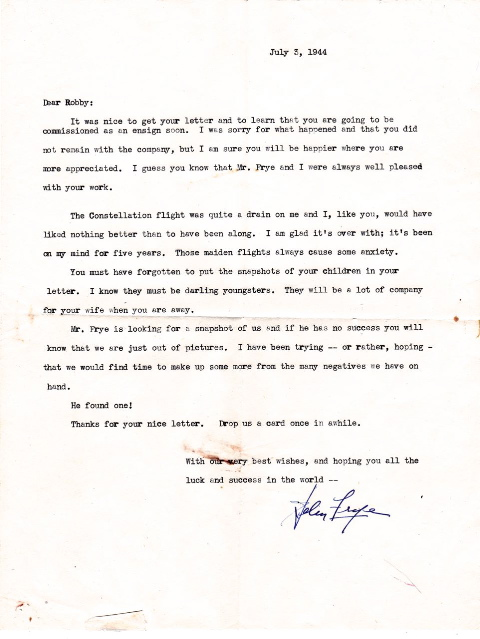
July 03, 1944
Dear Robby:
It was nice to get your letter and to learn that you are going to be commissioned as an ensign soon. I was sorry for what happened and that you did not remain with the company, but I am sure you will be happier where you are more appreciated. I guess you know that Mr. Frye and I were always well pleased with your work.
The Constellation Flight was quite a drain on me and I, like you, would have liked nothing better than to have been along. I am glad that it’s over with; it’s been on my mind for five years. Those maiden flights always cause some anxiety.
You must have forgotten to put the snapshots of your children in your letter. I know they must be darling youngsters. They will be a lot of company for your wife when you are away.
Mr. Frye is looking for a snapshot of us and if he has no snapshot you will know we are just out of pictures. I have been trying — or rather, hoping that we would have time to make up some more from the many negatives we have on hand.
He found one!
Thanks for your nice letter. Drop us a card once in awhile-
With our very best wishes, and hoping you all the luck and success in the world-
Helen Frye

(Above) we see the view of Oak Creek from the (now) House of Apache Fires building site.
January 25, 1943
Dear Mom, Dad & Peg-
Well I guess you are home now Dad. I would like very much to hear how things went. As you probably know by now I did not go to Washington D.C. When we arrived back here the evening of the 13th, Lois informed me that I was in Captains School, so there I have been ever since. We are supposed to complete the ground school work about the middle of next week. Then comes about 30 or 40 hrs of Transition in DC-3 equipment followed by 70 hrs of line checks. Line checks are when you fly with a check pilot as acting captain, and he gives you training in the duties of captain while you fly the regular passenger scheduled flight from Kansas City to New York. When that is completed, you take your flight test for Airline rating, and you are a full-fledged Captain. They seem to feel we will be going right through, and be all finished up by April. I for one certainly hope so. Well the Company Dr. has pronounced me as physically sound. I completed my annual company physical taking 1 1/2 days the 21st and 22nd. Boy it is some exam. They test your heart, lungs, breathing, blood pressure, hearing, take blood samples and type your blood, they feed you barium and with the fluoroscope watch it go through you. Altogether they took 6 large x-ray pictures and full mouth teeth x-rays. This was followed by a very complete eye test. And he couldn’t find anything wrong with me.

The Frye Deer-Lick Ranch at Sedona purchased subsequent to the second parcel (now called Smoke Trail Ranch) Red Rock State Park. Bob took this image from the air in (1942).
February 3, 1943
Dear Mom, Dad, Aunt Peg-
Well things are beginning to happen. A meeting was called yesterday afternoon of all student Captain (27 of us). It seems that the Company does not have a plane available to give us one DC-3 transition in. The army has allotted a large training program to us to train new Army pilots to fly DC-3’s. So — the results are they expect to give us one transition in the Army planes, then we will work as instructors until we are needed as Captains on the regular passenger and cargo runs. By so doing we will get 3 or 4 months experience as first pilots on DC-3 equipment. When it comes to line checks, we will be able to put all our attention to learning the procedures, as we will be thoroughly familiar with the airplanes and weather flying. I personally am very much for it. I believe one learns a lot more about an airplane teaching some one to fly in it, than any other way. These boys they expect us to teach have about 150 to 200 hrs in single engine planes. We are supposed to give them 25 hrs covering take offs and landing, instrument flying and single engine emergency procedures.
February 4, 1943
As I told you in my last letter, we completed Captains school Tuesday noon and are now waiting for our turn for transition. There present plans, as expressed today, are for us to start the 15th, and be completed by the first. Then we are to instruct Army pilots who have just graduated from Randolph Field and who have just received their commissions as 2N Lts. They each have between 150 and 200 hours of flying time (Dual and Solo). It will be no picnic that is certain, as they are a bunch of cocky, self-centered, and know-it-alls. We are supposed to make DC-3 first pilots out them in 25 hrs. This is twice as bad as CPT they were at least confined to small planes.’

(Above) we see another color image taken by Jack and Helen’s friend and co-pilot Russell (Bob) Robinson (1942). Please note in both images (here and above) Helen is wearing her buckskin coat (taken on same hike around hike).
February 15, 1943
Dear Mom, Dad, & Peg-
Well I am still doing nothing waiting for my DC-3 transition. The way it looks now, it will be the 1st of March or later before I even start. I haven’t even flown a plane since January 13th, when I was with Frye. One month and I am about to go nuts. Times like this make me wish I was in the Army. I could have gotten a Capt. commission a while back too. There is so darned much flying to be done, it is a crime that several hundred pilots should be sitting around idle…. Well I guess there is nothing else to till this time. If something doesn’t turn up pretty soon I’m going to do some investigating. Mr. Frye left for Washington D.C. January 15th and hasn’t returned yet. As soon as he does I am going to talk to him about the way things are going.

The photo (above and on header of this page) was offered to me in (2004) by one of the nicest people I have ever had contact with through this webwork and the subsquent Frye biography book. Her name was Joan LaPlace (now passed away) who contacted me and inquired as to the provenance of the images and asked if wanted them. She stated she bought the black & whites in a ‘lot’ with other Frye items at an auction in 1994. After conversing back and forth I deduced they were originally from Jack’s personal collection and some of the many items lost by his family after he died. Likely the photos were captured by Helen Frye or maybe one of Jack’s TWA co-pilots (several I have had contact with). The setting was captured at the Sedona Frye airstrip located at Cornville Road and 89 near the Sedona Frye Ranch (this by analyzing the horizons when I photographed and walked the location). The plane is Jack’s TWA Executive Lockheed Electra NC18137 Jack is holding his trademark cigar (seen in header of this page) and likely had just landed judging by his wrinkled clothes. Frye was known to be a meticulous dresser and surprisingly I have yet to find an image of him piloting this Lockheed when he wasn’t dressed in a coat and tie. Jack, more than not, served as Pilot/Captain of this Lockheed and many times flew the ship solo. What were the instances where Jack didn’t serve as Captain? When he had to conduct business in the cabin (many times with business associates or guests of TWA) thus the need for a co-pliot.

The ‘Flight Research Laboratory’ and ‘TWA Research’ as stenciled on the fuselage and nose of the Lockheed Electra 12A Junior was what impressed the public most when seeing this plane coming and going at airports around the nation (1940-1945). What a great clear 5 by 10! Owned by Sedona Legend.
As reflected in the image (below) the Electra was constantly maintained by TWA ground crews (shown) is Chester Calkins. This stellar TWA service enabled the ship to be utilized by Frye on a moment’s notice. This Lockheed was in constant use by Frye and crisscrossed the nation bi-weekly by Frye on TWA business. The photo was taken when Robby was the pilot of the plane.

(Above) Frye L12 @ Washington D.C. Lockheed model 12A, NC18137. Appropriately called “Research” as seen in a TWA employee publication photo (Skyliner Magazine). Jack worked at the TWA executive office in Washington D.C. and lived with Helen at the TWA executive residence (Doubleday Mansion) Falls Church (Arlington) Virginia. Jack’s executive transport Lockheed Electra 12A was often seen parked at the DCA TWA Terminal at the ready for Frye’s arrivals and departures. (Photo 1942).
February 16, 1943
Dear Dad-
Thanks an awful lot for your letter and offer of help. I do not believe it is going to be necessary for me to get a car. The instructing proposition has blown up. First, the Army did not give us as many students as they said they would; second, the junior captains and reserve captains raised a big fuss about it, and third, the Airline Pilots Ass. objected very strongly. So – now my chances of getting any DC- 3 transition are very slim. It is pretty discouraging. If it wasn’t for Lois, I would be in the Army. The way I feel, that is just where I want to go. There I would not have to worry about not getting any flying, and I would also be getting darn good pay. I believe that if one doesn’t make and save anything now during the war, he is going to be in very bad shape after the War. Also I would feel that I was contributing some real help to getting this war over with. I haven’t been up in an airplane since the 13th of January, if I don’t fly soon I will go nuts. And they say there are no further prospects of my being checked out this year. Well that is enough about my woe’s, I suppose the disappointment has intensified the darkness of the situation.
March 24, 1943
Dear Dad, Mom, Peg & Ted-
I don’t know if you have written since the first of this month or not, a I left KC the morning of the 3rd for Washington D.C., and I am still here. Mr. Frye expected to be here only a week, but three have gone by, and we are still here. I spent the first two weeks studying for the written exam for my Airplane and Engine Mechanics License. Boy were they tough, I think I passed most of it, but not all. They are each divided into 5 parts, with a total of 300 questions per exam. At least I know exactly what they expect now, which is more than I did before. Well, we should be going home pretty soon, I will write a real letter when I get there. right now I have to do something for Mr. Frye, so will close. Hello to all and keep well. Mrs. Frye spoke of going to the west coast soon after we get back to KC, so maybe I will be able to see you all. Who knows? Love, Bob
(Following) image is a current Forest Service overview of the original Frye Airstrip, christened the Verde Valley Airport, imagine my surprise when I saw that the airstrip still appears on maps. Because of the war, Frye was unable to develop the airstrip as he desired, so it remained the Frye private/public Airstrip. Few know that it was Jack and Helen Frye who walked off Tabletop Mountain, long before the current Sedona Airport was ever envisioned, let alone developed. This airstrip is pre-Sedona Airport (SDX & SEZ) and it must be reiterated that Jack Frye of TWA discovered the now site of the Sedona Tabletop Mountain plateau of the present Sedona Airport. This conveyed Sedona has a prominent connection with TWA President Jack Frye from 1941. After Jack and Helen Frye walked off the property Frye for whatever reason decided on the property at Cornville Road and 89A. This property was graded and improved to handle landing the Lockheed Electra 12A Junior (by fall of 1941) and later the TWA Lockheed Lodestar 18. Jack and Helen landed here often on east-west-coast trips to spend time at their ranch. A heretofore fact is Howard Hughes landed here several times in visits to the TWA Ranch.

‘Circle the ranch twice in a low pass’ this was related by interviews with (now passed away) ranch hands. Whenever Jack and Helen would come out to the ranch from the Washington D.C. or Los Angeles, Jack would circle the ranch twice in his Lockheed 12A or 18. The flash of polished aluminum and the throbbing of the dual 450 H.P. Pratt & Whitney engines reverberating over the property was a signal for the ranch hands to drive out to the Frye airstrip where the Lockheed 12A or Lodestar 18 had landed with Frye guests. A rare event for Sedona at the time in seeing the TWA twin flying over the valleys and red rocks of Sedona. (Early on there were no phones at the Frye Ranch thus the signal from the Lockheed).
One of the very first things Jack did after he bought his Sedona property was to start searching for private airstrip for access to the ranch this because of his responsibilities with TWA which only allowed access to the property by air. There was no airport in Sedona at the time (1941) and landing locations in the Red Rock Country were primitive at best. Frye’s Sedona Ranch did not have a section of land flat enough for an air strip and there were too many navigation hazards. Occasionally the Frye’s landed at Clemenceau Airport at Cottonwood, and more commonly the full-service TWA terminal at Winslow. (The Frye Sunshine Ranch was near that location). They also landed at the Valle Airport as they had another ranch nearby at Spring Valley Arizona.

Seen above is a view of Cathedral Rock at Sedona seen from the air- taken by Frye TWA pilot Bob Robinson (1942)
March 25, 1943
Dear Mom-
I am sorry I bothered you, but here is the situation. I have been away 4 weeks now here in Washington. Although I haven’t done a great deal it has been very important that I stay here. I called Lois on the phone last week, and Beth had fallen and split the scalp on the back of her head necessitating taking her to the hospital and several stitches had to be taken. Lois said everything was now getting along OK. I didn’t hear for several days, so yesterday I called again, and infection had set in and she had had Beth to the hospital every day for a week, and they were having to drain it. The doctor said it wasn’t necessary to keep her in the hospital, but Lois had to take her down everyday. About half way through this call Lois started crying and I am afraid that everything plus my being away so long plus a homesickness she has had for you and her folks plus the fact that it is only two months till the baby is expected was beginning to tell on her. I am afraid she will overdo and hurt herself or the baby. She is a lot like you Mom, she doesn’t complain till she drops and everyone can see that she is done up. She told me the worst was over and not to worry, but I know she hasn’t been able to get help. Peg I am afraid would only make matters worse, much as her intentions might be good. So far no financial help needed I don’t know when I will return it may be Tuesday, or 2 weeks yet, I am acting as Mr. Frye’s assistant at the present. Love Bob

March 31, 1943
Dear Mom-
Received your letter this evening and was very glad to get it. I did not expect you to be able or even consider your taking the train. I knew you could make the plane out of San Francisco to Boulder City, and so on, to Kansas City, OK. It is not hard to get from San Francisco to Kansas City, but it is very difficult to go from Kansas City to Boulder City. If it becomes necessary to take Beth to California while Lois is in the hospital, Mrs. Frye said we could take her out in the Lockheed. The thing that worries me is that I am away so much, and Lois is really very much along. All of one relations are out in California. The few that are in Kansas are or couldn’t be of any help in an emergency. After all Eleanor has John’s folks near by and other friends besides. It isn’t that I begrudge her any it is just that I must be away a lot, or I won’t have a job, and we have absolutely no one to call on but our folks, and they are so very far away. I think I am going to have to move to the West Coast soon for Lois’s and Beth’s health’s sake. They have had more colds and other things here than all the rest of the time put together. Well Mom I hope to see you soon. Who knows, I may be in the Army very soon, that is another good reason for wanting Lois & Beth better taken care of, mentally as well as physically. In Lois’s condition, I am afraid it would be very hard on her. At this time of all times. I am not trying to scare anyone, but I am just the right age, and I am in a position to know more about what is going on regarding such than you have any idea. After all Mr. Frye hasn’t been spending every day all day for a week in conference with such men as General Arnold, Marshall, and George (Harold Lee George) for nothing. Well keep well, and do something with that ranch for heaven’s sake. If Uncle Harrison wants it kept, why doesn’t he do something about it? Love to all, Bob
Interesting side note, in visiting a close friend, Fran Elliott (her home is located at the base of Tabletop Mountain Sedona Airport, she showed me an electrical switch and wires which led up the hill to the Sedona Airport. She related that in the early days, before the airport was developed, the owner of her house, a pilot, would have his wife or whoever flip the switch, which would turn on the airport runway lights so he navigate at night! I doubt that anyone in Sedona knows this little bit of aviation history!
Two airport locations considered by Frye for his Sedona TWA Ranch. The first location was where the current Sedona Airport is today on Tabletop Mountain. Jack and Helen Frye considered this flat top mountain in the summer of 1941, as Jack had spotted it from the air while searching for suitable landing locations. The Frye’s walked off the perimeters together and found it suitable for an airstrip. However, for whatever reason, Jack felt a second location was more feasable for his needs. The Sedona Airport was eventually developed in part by Joe Moser, but it can be truthfully stated that Jack Frye of TWA was the first to survey this location for a future Frye landing strip. This per Helen Frye (Red Rock News interviews). Development of airports were nothing new to Jack Frye, in the 1920’s he owned the largest private airport on the west coast (Aero Corporation Field) at Los Angeles. He was responsible for the development of the 1st passenger air service, Interstate and Intrastate, (California to Arizona) and later El Paso. Frye held the 1st commercial license ever issued by Arizona and flew the 1st commercial flight to Arizona (1927). He is officially credited with development of the current Albuquerque Airport and was instrumental in pushing for the current location of LAX, even to the point of stating TWA would no longer land at Los Angeles if a new improved airport was not developed. El Paso airport was also developed by Frye’s Standard Air Lines. All this said, the 2nd Sedona location Jack Frye located was the (now) stoplight of Cornville Road and 89A, north of Cottonwood (Bridgeport) Arizona. Frye found property here which was available (N.W. corner of the intersection) which even today is still open land. At that time, however, this was the flattest land close to the Frye Ranch which could serve as an airstrip. Jack secured the location and had it graded, improvements consisted of buildings and service facilities. Wisely Frye developed it as a private landing field for his two Lockheed’s (the TWA Lockheed 12A Electra, and later, the TWA Lockheed 18 Lodestar. Both these powerful twins needed a long enough runaway for takeoff and landing. Jack envisioned the development of this location for commercial or Army use, but because of the war this was stalled, according to local media.

In May of 2010 I walked off the Frye Airstrip property, little could be identified as to the Lockheed runaways after nearly 70 years, but I found a few clues. The raised line of rocks bordering a long stretch of flat cleared land was one of the clues (seen above). All landmarks of any kind were difficult to discern except the pile of rocks (below) which I feel were from the original clearing of a runway for the Lockheed 12. Also seen were a couple unidentified rusty artifacts, perhaps a well head and pressure tank? The Frye airstrip today is a lonely place, the perimeters hard to discern but from the air and satellite photos of which the runways are clearly revealed. I have hiked the (now government land) many times. The land has been reclaimed by sagebrush and scrub, and no one would ever guess at one time Transcontinental & Western Air (TWA) planes landed and took off from this lonely locale. As I stated, the main runway is hard to locate from the ground but after some hiking around I was able to find the perimeters where rocks are still graded up along the airstrip boundaries. The runway was surprisingly long, over a mile in length, and at least 150 feet wide, the gradient, a slight incline to the north. Recently, Cornville Road (Forest Service Road #119) was extended west (Mingus Avenue) and was built over the southernmost portion of the main runway. The (service exit ramp) is about 1/2 mile long. In media coverage (in regard to the Army’s use of the location) the site was said to be leased by Frye and had 2 runways. The main runway was said to be easily extended to three miles due to the flat terrain. Now you know what kind of property Jack was looking for in an airfield for the Verde Valley-Sedona area. There were fueling facilities and some buildings built in the 1940’s, the ruins of which are to be found today. A lone rusty 5-gallon fuel can sits on the edge of the runaway. Many locals insist Jack and Helen owned the property outright, however one person relates the land may have been leased from the school district (Jack formed an airport committee to help develop the location). Jack flew in and out of the field regularly for the next 9 years, or so, (4-years with his L12, and 3-years with his L18). Unfortunately, because of the war, the location was never to become a regional airport and eventually was forgotten by locals. Jack once stated that Verde Valley was of interest to TWA because of its excellent flying weather at practically all times of the year. Today, standing on the windswept sagebrush flats, one can easily drift back in time and hear the throaty roar of the Electra or Lodestar radial engines, as the Frye’s landed and departed.

October 24, 1941
Pre-Halloween Flight from ABQ: As was typical Jack stopped at TWA Albuquerque on business and to refuel. He happened to run into an old friend Timothy Riordan from Flagstaff, and Jack and Helen offered him a flight home on the Lockheed Electra Jr. The current airport at Flagstaff (Pulliam) was not developed at this time instead Koch Field was the Flagstaff main airport. Frye first met Riordan on November 22, 1927 when he had taken him and his wife for their first flight over Prescott, Arizona, on a brand new 8-passenger Standard Air Lines Fokker airliner. Jack made 6-promo flights that day with guests, even to the destination of early Jerome. Frye was in Prescott as the honorary guest at the Arizona Industrial Congress meeting and was staying at the famous Prescott Hassayampa Hotel. Riordan details his flight with Frye on this day: ‘Jack Frye, T.W.A. President, and his wife, picked me up at Albuquerque, N.M., October 24, 1941, at 10-10 a.m., and dropped me at Koch Field, Doney Park, Flagstaff, at 11:45 a.m., same day. Great Treat! T. A. R. (Timothy A. Riordan).’ So how was the flight on that Friday afternoon in Jack’s Lockheed 12A? Flight miles from Albuquerque to Flagstaff, distance 329 miles, time in the air, 1 hour and 35 minutes, speed of the Lockheed twin at cruise, 226 m.p.h. (averaged). Power plants, twin Pratt and Whitney R-985 engines, 450 H.P. each, combined 900 H.P. Without a doubt, this Lockheed was one of the fastest, most sophisticated executive planes ever designed, even by today’s standards! The Frye’s landed at Koch Field (which is now a housing development) deplaned Riordan, and took off for the Frye Airstrip, at Cornville Road and 89A.
This trip coincided with an event covered by local newspaper media of opening and dedication ceremonies of the Frye landing field, which was officially dedicated on October 25th, 1941 and officially christened the “Verde Valley Airport”. On that day, over two hundred people attended the event, and on this important October day excited local people listened to the guest speaker (TWA president Frye) who not only was one of the best pilots in the country but a national aviation celebrity as well. In his speech Jack talked about the future of Verde Valley aviation and TWA. After which he took local aviation officials on flights over the location in his ‘private Lockheed plane’ as a newspaper writer coined it. Jack always shared his accomplishments and it was only logical for him to open what was originally meant to be his ‘private’ airstrip for public use and the Army.
April 8, 1943
Dear Dad and Mom-
I am home again for awhile. We left Washington Saturday April 3rd at 3:47 PME. Mr. Frye had an appointment with a man in St. Louis for Monday morning, but Mrs. Frye was afraid if we waited in Washington a bit longer, something would come up and keep us there. Mr. Frye had worked so hard and such long hours, he had made himself sick. The doctor couldn’t find anything wrong with him except an excessive nervous strain. To make a long story short, we went from Washington to Nashville Tennessee where we stayed Saturday night as the guests of the Vultee Aircraft Corporation’s owner. Sunday morning he took me to the factory where they are building dive bombers for the British and U.S. Army. We left there Sunday afternoon and went to St. Louis for Sunday night and Monday morning, returning to Kansas City about 2:00 PMC. Monday. It was 34 days 7 hrs since I left the house. At present I am having my teeth taken care of, had a tooth pulled yesterday, left 1st molar. I have two wisdom teeth yet to come out and two to be filled. The reason I lost this tooth is because decay set in under the filling. (Courtesy of Moyar of Salinas). In addition to my teeth, I am waiting to get my DC-3 transition, which will be followed by line checks and final OK as a regular Captain. If nothing goes wrong, I should be through by the tenth of June. Than I hope to take my vacation. While I am waiting around, I am working with another TWA pilot overhauling and repairing private airplanes for $1.50 per hr. We have more work than we can handle, and expect to hire a couple of mechanics a helpers.
April 19, 1943
Dear Mom & Dad-
You can bet it was a very pleasant surprise to hear from you on the phone the other night. Lois and Beth got off OK and arrived sometime Friday evening. I got a telegram saying they arrived OK, but no letters yet. Received your letter from Portland today. Tell Ted he could write me a letter, that I would like very much to hear from him. Well I am finally getting on toward checking out as a captain. I have 7 ¼ hrs out of the 12 hours DC-3 transition we receive, and then comes line checks. They are supposed to start around the first of May. The really tough part is just getting started. Right now I am trying to master the DC-3 under all conditions, single engine etc.
(Below) is one of the earliest images of the Frye’s at their ranch waiting for their ranch foreman (Roy Kurtz) to drive them out to the landing strip where the Lockheed Electra 12A was parked (late 1941).

TWA President Jack Frye was the busiest executive of TWA from (1930 to 1947) indeed it was Frye who created the airline we know today, from infancy through the first TWA Trans-Atlantic and Around-the-World service via the Constellation Airliner, envisioned and developed by TWA and himself, with Howard Hughes financing. (Below) Jack is captured on one of his escapes from his demanding schedule aside his TWA Lockheed NC 18137 twin on a fishing trip, likely shared with airline contemporaries and or business contacts. The image was offered to me by Jack’s late sister Sunny Frye.

Jack & Helen Frye resided here on their Smoke Trail Ranch. Because of the huge Willow tree beside the house the house was called the ‘Willow House’, still today. The Frye’s had it completely remodeled in 1941. That said the Willow tree was very happy residing on the edge of an irrigation canal!
Jack & Helen with guest Howard Hughes, and TWA Pilot Russell (Robby) Robinson
‘Slug-out’ at the Frye Ranch, like the Texas-bred men they truly were, Hughes and Frye play out a brawl akin to a Western Movie @ the Frye Ranch, truly the ‘Old West’ Sedona Arizona!
The following story told by Robby to his family is hard to date; however, according to Robby’s letters he documented two trips out to the Frye Ranch at Sedona. The date of these two trips were on November 11, 1942, and another, the first couple weeks of January 1944. Robby may have made other trips that were not mentioned in his letters. The key to the following story is “fishing” which might indicate a seasonable time of the year. However, in Sedona, the weather is so favorable this trip could have occurred at practically anytime of the year. For now, we will go with a trip of November 1942.
On this Arizona visit Jack and Helen flew out to their Sedona ranch to meet Howard Hughes. Robby was on board as co-pilot. As typical of Jack and Helen Frye, the crew of their private planes were always welcome at the ranch. However, typically, Jack lodged his pilots at Frank Eden’s Motor Court in downtown Cottonwood. This location was easy access to Frye’s private landing field near his ranch, and at times, Clemenceau Airport, this where Frye tied down his TWA Lockheed’s. It was typical for Frye private TWA hostess Harriet Appelwick to stay at the ranch; however, she flew primarily on Jack’s official TWA Lockheed Lodestar from, 1945 to 1947.
After Jack and Helen arrived in Sedona, they met Howard at the ranch. Hughes stayed at the Frye Ranch several times, generally under an assumed name, so the press wouldn’t track his whereabouts. Jack and Robby drove a Jeep about a mile over to the adjoining Frye-Deer Lick Ranch where the Frye’s had a guest house. They drove Howard back over to the Willow House where Helen and Jack always resided when at the ranch in the early days. It is assumed they all had a few drinks, at which point, Jack said, “let’s go down to the creek and do some fishing”, Helen elected to stay behind. Jack and Howard proceeded to walk down to an area of Oak Creek where Jack liked to fish while Robby followed closely behind. On the way, Robby was a little taken aback on observing Howard turn to Jack and say, “how ‘bout you let me sleep with Helen tonight?” Jack didn’t say a word, but instead whirled around and slugged Howard so hard, he fell off the trail into the creek. A stunned Howard was thrashing around in the water when Jack ordered Robby to, “take this S.O.B. off my property and drop him off at the airstrip!” Robby did as he was told and drove Howard out to the Frye Ranch airfield where he dropped Hughes off at his plane. Of course, we all know Jack and Howard obviously got past this slight as they continued to work together and socialize even to the development of the TWA Constellation 049. As a matter of fact, Howard was the last man to meet with Jack before he died in 1959. But, why would Howard say such a thing? Perhaps such; Helen was a very beautiful and sensual woman, and it’s a well-known fact that Howard tried to “bed” every attractive dame he met. I suppose on this visit to the ranch, out of several, he decided Helen looked just a little ‘too’ ravishing! Helen knew Hughes through Jack and TWA, and as well, he stayed at the Frye Mansion at Washington D.C. often. Howard and Helen shared a bond of sorts, but it was never intimate. I think Helen just felt sorry for the millionaire misfit as did many of Howard’s associates. In my mind, Howard always lacked the ability to interact in public. I think he felt because of his millions and the way people catered to him he could ask anyone for anything, yet at that, Howard was an awkward and humble man. Jack wasn’t this way, and I think Howard respected him like a brother. Hughes was lucky to have friends like Jack and Helen Frye; it was not the other way around! Hughes had very few “true” friends. Howard didn’t live by the ‘normal’ rules of society, his extreme wealth kept him from being conditioned by normal interactions with his peers, rather, it isolated him. There are many people out there who brag about having “known” Howard Hughes, but many of these people did not truly know him, nor did Hughes feel they were “family” but rather employees. The story above opens a window into the relationship between Howard and a man he considered an equal, not an underling. Jack and Helen Frye never wrote about all the experiences they shared with Howard. As close friends they had too much integrity. Most of these moments are now lost forever. This may be the first and only time a friend slugged Howard Hughes so hard that he fell down an embankment and into a creek for being disrespectful, all regard to the beautiful, enchanting Helen Frye! Jack was always a man of honor and integrity; he respected a lady.
The story as it appears above is the general version as told by Robby through the years to his immediate family. It has been transcribed into a printed “story format” by me with historical facts interpreted as they would relate to this event. Also, many were witnesses to Howard visiting Frye’s at their ranch (one such account follows). It’s a myth all Howard ever drank was “pints of bottled milk”. Also, quite interestingly, the last person Jack met the night he died, as result of a drunk driver in Tucson, Arizona, February 3, 1959) was Howard R. Hughes. This meeting took place at the Raytheon, Falcon Missile Facility, (verified).
According to Robby’s daughter, Dorothy, “My Dad was not personally fond of Hughes after that incident, Dad felt that Howard’s motivation seemed to be, “whatever belonged to Jack was Howard’s to share, and he had been drinking.” My dad really liked Helen, he would tell the story whenever someone made the news for “saving” Howard Hughes.” Dorothy Nylen

Image above shared by Jack’s sister Opal (Sunny) Frye, when I spent the day with her at Hermosa Beach I found her to be absolutely charming and a wealth of information about her brother Jack and the TWA years. This is a cropped version of the image, the original shows a TWA co-pilot just out of frame holding the other end of the line with hanging fish (location unknown) notice, however, the Lockheed is parked on tarmac. The plane was purchased by Transcontinental & Western Air, Inc. (TWA) for use as an executive plane to serve TWA President Jack Frye. This Lockheed was occasionally utilized as a TWA “flying laboratory” research plane (utilized by TWA Chief Test Pilot Tommy Tomlinson). It was always reserved for Jack Frye’s use however and saw TWA service with Frye between September 1940 to December 1944. This Electra was used by Jack and Helen Frye to discover and purchase their famous Sedona Arizona ranch (now as Red Rock State Park) in 1941.
April 25, 1943
Dear Mom & Dad-
How’s things? This has been a pretty lonely day for me. It was raining when I woke up this AM, it was instrument weather so I stayed home and cleaned up the house. Did I tell you I had joined the Civil Air Patrol. I am a 2n Lt., and I have charge of light training. Next am to receive the rank of 1st Lt. and Master pilot rating, the highest there is. We wear regular army uniforms and insignias except for red shoulder straps and silver instead of gold ornaments. We are treated as regular Army personnel in all cases. It is pretty good too, for if any of us were to be called by draft boards, we can go on active duty with the rank and pay we hold in CAP. Yet we cannot be called except by our draft board.
April 30, 1943
Dear Dad and Mom-
My flying with Mr. Frye is costing me a lot right now. I came up for change from apprentice to regular member of the Airline Pilots Assoc., and because of my flying with Mr. Frye it was refused, or in other words I was kicked out. That is another good reason why I want to get away from here. I applied to Douglas Aircraft Company for a job as engineering test pilot provided it was permanent, both now and after the war, and I am waiting to hear from them. I have been reclassified 3A3 by the Draft Board. Well write as often as you can and want to. I more than welcome letters now. Love, Bob
May 9, 1943
Dear Mom and Dad-
I am flying schedules again now. Flying into New York that is, until I start line checks. I will very likely not fly with Mr. Frye any more. It has caused me no end of trouble. The whole thing is this – Some of our pilots are very jealous of the fact that I flew with Mr. Frye and because he let me fly his ship. As a result I have been refused regular membership in the Air Line Pilots Ass. or in other words the Air Line Pilots Union. The result of that are that the check pilots will not OK anyone to Captains status unless they are members of the ALPA, as I am not my chances of every becoming a Captain are very slim, about one in one-hundred. I am going to try for it anyway and also I am going to try and straighten out the misunderstanding those jealous pilots have….. Well we leave tomorrow for KC at 11:00 AME, so guess I will close for this time. Bob

June 12, 1943
Dear Mom & Dad-
Just a line to say hello, and tell you I haven’t forgotten you. I have been terribly busy. I have been operating an Aircraft Repair Shop as well as my CAP activities and TWA. I am going to try and take my vacation next month and I’ll be out to see you if I do. My troubles at TWA (ALPA) are coming to a head, and the results may be that I will leave TWA. The ALPA is bringing pressure to bear on all the Captains, causing them to refuse to fly with me, and to make it impossible for me to check out as Captain. I was supposed to have started line checking the first of this week, but the check pilot wouldn’t accept me. The Chief Pilots Office is taking the matter up with the Vice-President and the Company Lowers are also working on the matter. They are supposed to have some sort of an answer, or information for me the middle of this next week. It is just another case of a “Dam” union.
June 17, 1943
Dear Mom and Dad- Received a card from Ted yesterday, from Florida. I was certainly happy and surprised to get it. Well, I went to Mr. Frye about this ALPA thing and he spoke to the V.P. Mr. Collings. I also contacted Mr. George Rice, our Chief Pilot. I don’t know exactly what the outcome was, but at any rate I was told I would start my line checks upon my return from this flight. He told me it would be a very rough go, but they were behind me. I am certain Mr. Frye had a lot to do with it.
Althought not Jack’s TWA 12A, the following image of a similar Lockheed 12A reveals a ‘polished to a mirror finish’ Electra idling on a runaway. This would have been exactly the appearance of the Lockheed Electra NC18137 during it’s TWA ownership. You can see why so many remember the brillant reflection of the TWA Lockheed as it flew in and out of Sedona, or as one local aptly described it, “you could see the plane for miles parked at the Frye airstrip, a blinding mirror as reflected by the Arizona sun. Unfortunately, currently, the plane’s finish today has been destroyed by painting over the aluminum with silver paint.

July 1, 1943
Dear Dad and Mom-
I am line checking now. I expect to make three trips, (30 hrs) and then have 90 days to study in, then go back and make four more round trips (40 hrs). I have it second hand that the biggest reason for my being refused by the ALPA, is that Mr. Frye has started things in the Company towards placing me in some sort of a job as soon, or soon after I have checked out and I am a Captain. I don’t believe this is all just idle rumor, as Mr. Collings (our vice-pres.) and the Chief Pilots Office are trying to help straighten this ALPA thing out, and also, the Captain who is giving me my line checks, made this remark yesterday. “The Chief Pilot’s Office is bending over backwards to see that you get checked out for some reason.”
September 21, 1943
Dear Mom & Dad-
Well things are going along very smoothly now. I hope they continue to do so. Day before yesterday, Sunday, the dispatch office called up and told me to come down right away and test fly the Lockheed. Mr. Frye had requested that I do it for him. Mr. Roby, as chief pilot, had test flown it and missed a lot of things, so he told them to get me after that. I contacted the powers that be in the ALPA and received their OK before I went to the field though. One of the head men of the ALPA, that gave me a lot of trouble has gone to the ICD, so I won’t have him to fight any longer. I have hopes of getting that situation all straightened up soon.
November 3, 1943
Dear Dad & Mom-
I am still trying to get the ALPA business straightened out. I saw the international president in Chicago, October 28th, and I am now waiting to hear from him. I am trying to get that straightened out before I do any more line checks, the check pilots just won’t pass me unless I do, and unless that is straightened out or I quit, TWA will release me. Mr. Frye has, I find, ordered the Chief Pilots Office to see to it that I am checked out to Captain. He did this with best intentions, but it has only aggravated the situation. If I leave TWA I am going to try to get a job as test pilot with North American here.
Jack and Helen Frye (below) at their Sedona TWA Ranch, one of the earliest images of the couple taken in 1941. This image was later featured in a Fortune Magazine profile on Jack Frye.

November 6, 1943
Dear Mom and Dad-
I am still up in the air as to the outcome of my mix up with the Airline Pilots Association. As I told you I went to see the President of the ALPA International while I was in Chicago last week. He expected to be in Kansas City and said he would see if he couldn’t straighten the mess out this week, but I haven’t heard from him yet, so don’t know what is going to happen. I have at least succeeded in getting any further line checks postponed until I get the ALPA situation settled. I am going to New York on a flight with the Chairman of the KC chapter of the ALPA. I hope to be able to possibly get some of this straightened out.
December 6, 1943
Dear Mom & Dad-
Just a note. Received Dad’s letter and we were certainly glad to get it. I am more than busy at the present time with a possible change coming up. The Army has discovered that TWA has too many pilots, and my draft classification has been changed from 3A3 to 3A and will be changed to 2B very shortly. There has been no change in ALPA yet and I am just here, no more live checks for a while. Will write and keep you as up to date as I am myself. I may have the opportunity to end the Air Corps as a multi-engine instructor but know very little about it as yet (military leave from TWA). All are OK here, Love Bob
December 6, 1943
Dear Mom & Dad-
Just a note. Received Dad’s letter and we were certainly glad to get it. I am more than busy at the present time with a possible change coming up. The Army has discovered that TWA has too many pilots, and my draft classification has been changed from 3A3 to 3A and will be changed to 2B very shortly. There has been no change in ALPA yet and I am just here, no more live checks for a while. Will write and keep you as up to date as I am myself. I may have the opportunity to end the Air Corps as a multi-engine instructor but know very little about it as yet (military leave from TWA). All are O.K. here, Love Bob
The Flights:
All the following flights were in Frye’s personal plane, Lockheed 12A, FAA Registration Number: NC18137
Notation on passengers:
Jack Frye’s passengers on his private Lockheed’s were not always notated; however, they often included Mrs. Jack Frye (Helen) who spent much of the time traveling with her husband. As well, often Jack would offer rides to anyone who was going his way, whether it be corporate associates, TWA flight personnel, or United States enlisted servicemen, as found on standby at Transcontinental & Western Air terminals across the United States. Airport Code key can be found at the bottom of this page.
October 2, 1942 (approximate time frame)
Crew: Frye/Robinson
Passengers: Unknown
MCI (KC-Kansas City) to DCA (WA-Washington D.C.)
Flight time 4 hours 25 minutes DCA to MCI
October 21, 1942
Crew: Frye/Robinson
Passengers: Unknown
MCI to DCA
October 30, 1942
Crew: Frye/Robinson
Passengers: Unknown
DCA to STL (St Louis) to MCI
November 19, 1942
Crew: Frye/Robinson
Passengers: Helen Frye
MCI to AMA- AO (Amarillo)- or ABQ- AQ (Albuquerque) to (WO) INW
INW (Winslow) (Frye Sunshine Ranch) to Verde Valley Airport (Frye Deer Lick Ranch).
Landed at Semi-Private Frye Airstrip (VVA)
November 19, 1942
Crew: TWA Pilot Russell (Bob) Robinson
Frye Verde Valley Airport (VVA) to INW
November 24, 1942
Crew: Robinson
Passengers: None
INW to PHX (Phoenix Sky Harbor)
Crew: Frye/Robinson
Passengers: Helen Frye
PHX to ELP
Note: El Paso-Standard Airfield was developed by Jack Frye when he was President of Standard Air Lines/Aero Corporation, a predecessor of TWA.
November 25, 1942
Crew: Frye/Robinson
Passengers: Unknown
ELP to MCI
December 1, 1942
MCI to OKC (Oklahoma City)
Crew: Frye/Robinson
OKC to CRP (Corpus Christi)
Crew: Frye/Robinson
Passengers: Congressmen; John J. Hardin, Dan Tankersley, Jack Nichols
Destination: King Ranch for hunting trip
December 7, 1942
Crew: Frye/Robinson
Passengers: As notated above
Return flight: CRP to OKC to MCI
December 28, 1942
Crew: Frye/Robinson
Passengers: Jack Frye family (father and stepmother) Dr. William W. Frye, and wife, Laura
Roundtrip
Outbound (possibly December 29, 1942)
Ship iced-over, pulled into TWA hangar, sprayed with hot water and dried
Engines started at 11:40 a.m. – Departure delayed to 12:45 p.m. (ceiling 1500 feet)
December 28, 1942
Crew: Frye/Robinson
Passengers: Jack Frye family (father and stepmother) Dr. William W. Frye, and wife, Laura
Inbound
MCI to Twitty Texas (Arrival 2:59 p.m., time on ground 12-minutes)
Twitty to MCI (Departure- 3:11 p.m., arrival KC 5:28 p.m.)
Twitty was near Wheeler Texas and Frye Ranch (Texas Panhandle)
December 30, 1942
Crew: Frye/Robinson
Passengers: Helen Frye
MCI to CRW (Charleston West Virginia) possibly to drop off Helen or leave Christmas packages for Helen’s family
Unknown Date
Crew: Frye/Robinson
Passengers: Unknown
CRW to DCA
DCA to MCI
January 8 – January 13 1943
Crew: Frye/Robinson
Passengers: Helen Frye and guests
MCI to SFN (Santa Fe) to ABQ to INW to Cottonwood Frye Airstrip VVA to BLD
(Boulder City TWA Terminal and Las Vegas) to FAT (Fresno)
to SFO (San Francisco) to OAK (Oakland) to Davis, CA. to SFO to BLD to INW to
TUC (Tucson) to ELP to MCI
Arrival MCI (January 13, 1943, 6:19 p.m.)
January 15, 1943
Crew: Frye/Unknown First Officer
Passengers: Unknown
MCI to DCA
(at least 10–14-day layover)
March 3, 1943
Crew: Frye/Robinson
Passengers: Unknown
MCI to DCA
April 3, 1943
Departure time- 3:47 p.m.
Crew: Frye/Robinson
Passengers: Mrs. Jack Frye
DCA to BNA
April 4, 1943
Crew: Frye/Robinson
Passengers: Mrs. Jack Frye
Departure time- Sunday Afternoon
BNA to STL
April 5, 1943
Crew: Frye/Robinson
Passengers: Helen Frye
STL to MCI
Arrival KC @ 2:00 p.m.
Airport Codes:
For those former airline employees like myself I have included Airport Codes pertinent to the above narrative. I had to memorize 100’s of these when I was in airline school, and even though I never thought I could not remember them all, I received 100% on my airline test and was voted ‘MVP’ (Most Valuable Person) in my class. What an honor!
Please Note: Most commonly airport codes in the 1940’s were 2 digits
MCI (Kansas City, Kansas, original downtown TWA terminal) KC
DCA (Washington National, Washington, D.C.) WA
ABQ (Albuquerque, New Mexico) AB
INW (Current airport code for Winslow, Arizona) WO
ELP (El Paso, Texas) EO
CRP (Corpus Christi, Texas) QM
BLD (Boulder City, Nevada)
CRW (Charleston, West Virginia) KN
CMH (Columbus, Ohio) CO
OKC (Oklahoma City, Oklahoma) Will Rodgers Airport, OL
SFN (Continental Airport, Santa Fe, New Mexico)
FAT (Fresno, California) FT
SFO (San Francisco, California) SF
OAK (Oakland, California) OA
PHX (Phoenix Sky Harbor, Arizona) PH
TUC (Tucson, Arizona) TZ
BNA (Nashville, Tennessee) NA
STL (St. Louis, Missouri)
DWA (Davis, California)
KAVX (Catalina Island)
VVA (Verde Valley Airport- Semi-Private Frye Airfield developed by TWA’s Jack Frye)
(Airport Codes for Twitty Texas and Davis California are not known)
It is my understanding that Boulder-Vegas air space was severely restricted during World War II. Each time Jack flew in and out of this area it was quite difficult, as certain flight paths had to be adhered to necessitating a less than direct approach and departure. Boulder was the TWA terminal at the time (this per Frye private pilot TWA Captain Walt Gunn who also served as a Frye co-pilot occasionally in the early 1940’s and flew TWA 12A NC18137 in and out of Boulder with Frye and V.I.P. passengers.
November 5, 1942
Crew: TWA President Jack Frye
Passengers: Mr. and Mrs. Jack Frye
Private Flight (Roundtrip MCI- DL)
Timeline: (less than a week)
Emergency flight by Jack and Helen to Dallas, Texas on November 5, 1942. Jack’s beloved brother Don died suddenly in Dallas and Jack left as soon as he was contacted by the police. Jack would not have wanted anybody on board this flight (even a pilot) as it was one of the darkest times of his life.
Recap- Jack Frye committed all available pilots and TWA equipment to the U.S.A.A.F. to help with the war in the early 1940’s. This left a shortage of pilots within TWA for Frye’s private 12A. Unfortunately, jealousy and resentment from other TWA pilots who resented a “rookie” filling this coveted position caused so much heartache for this young man (Robinson) that he eventually left TWA for more harmonious employment elsewhere. However, before he left, he experienced a deep bond of friendship and camaraderie with Frye, as well as training with Transcontinental & Western Air- the world’s finest and most experienced (soon to be world) airline! It is a travesty that Robby did not receive more favorable treatment with TWA. It certainly goes without saying he was a stellar pilot and Jack Frye took him under his wing because he showed great promise. Certainly, his resignation was a critical loss for TWA and embarrassing as well. Jack Frye can be applauded for trying (despite how very busy he was) to rectify the situation. I was not aware there were union problems at TWA before the famous strike of ’46 which nearly put the airline out of business, but problems there were! Power plays and a lack of team playing can very well destroy any good company. Incidentally, Robby’s daughter had the following to say about what started the ‘blackballing’ of Robby, as seen below:
My father said that the problem he had with the pilot’s union was that Jack let him fly the Lockheed almost right away and on one flight Jack told a TWA Captain that he was going to co-pilot for my dad who was a co-pilot – that is where the trouble started.” Dorothy Nylen
Jack Frye never forgot a friend- you can take that to the bank! Be assured that he likely arranged the new position for Robby as an executive pilot for the Navy in Corpus Christi, Texas. According to his daughter Dorothy Nylen- “After TWA, my dad ended up in the Navy at Corpus Christi, Texas. He was trained to go to the South Pacific and fully expected to go. My dad later said that he had been called into the Admiral’s office and asked about his flying for TWA and Jack Frye. Then the Admiral asked him if he wanted to fly for him – my dad said he was slated to go to the South Pacific, and the Admiral was supposed to have said – ‘You have a family don’t you? What do you think they would want you to do?’ At that time my father had 2 children.”

National Aeronautical Association-
“No swivel chair executive- Frye still flies his company ship frequently (Lockheed 12) and it is no trick for him to schedule an early lunch in Kansas City (his headquarters) and keep a dinner engagement in Washington D.C. where he spends much of his time in connection with the war effort; all in a day’s work for this executive-pilot.” 1942
One fact need to be stated about Jack Frye and his career with TWA; Jack’s life with TWA was 24/7. In my opinion, there wasn’t any man involved with Transcontinental & Western Air in Frye’s timeframe who was as dedicated to the company as Jack Frye. This is just fact. The reason I mention this is because when Jack was in flight, as in the Vega, Gamma, Electra Jr., or Lodestar, he was nearly always traveling to and from TWA business meetings and engagements around the country. He regularly, several times a week, conducted business in the air with clients. Any occasion where Jack had the time to use a TWA private plane for personal business was more the exception than the rule, he didn’t have much of a personal life, period.
Jack Frye also flew on TWA passenger airliners regularly, at which, he was sometimes the captain, but more than not, he was seen working in a back row seat on TWA paperwork. This is why the press called Frye, the “Flying President”, and why Frye always had a private plane as provided by TWA. These planes were also officially designated as Flight Research Laboratories, as this was the way TWA justified owning planes not being used for scheduled passenger service. When these various planes were not in use for Jack Frye’s presidential business, they were used for flight research, another paramount endeavor of Frye and TWA. Regardless of what one might hear, these planes were not readily used by other TWA associates, except through the permission of Jack’s Kansas City and Washington D.C. executive offices.
Jack had very little private life, something all his wives were forced to accept. Jack’s spouses, too, were constantly at the beck and call of TWA with the entertaining and promotion of the airline. Most of the time, if not every time Frye visited his ranch in Sedona, or any of his other ranches, the layovers were scheduled only as he could stop in Arizona while in transit on TWA business flights. Helen, on the other hand, would fly out to the Sedona Ranch by herself more frequently on TWA airliners landing in Winslow with a ranch hand driving up to meet her plane. Jack loved the ranch in Sedona but understandably his time there was spent in stolen moments. Sadly, the longest continuous time Jack ever spent at the ranch in Sedona was after he resigned from TWA, and before he took over General Aniline and Film (GAF-ANSCO) in New York City. This was from the period of March to June of 1947. Helen resided with Jack at Manhattan up until 1950; however, she balanced this between managing their ranch at Sedona.

The image above (early 1940’s) found in Russell Robinson’s TWA years memorabilia as shared to Sedona Legend by his daughter Dorothy. A cherished memory by her father who as revealed on this page knew Jack personally and considered him a friend.

Christmas Card to Robby from Jack and Helen Frye. The photo on this card (used for several years) also graced a TWA Calendar. Jack Frye himself was responsible for the photo.

Closure:
“My father had- possibly still has sometimes- very fond memories of Jack and Helen. My dad will be 92 in March; he was born in 1917 and would have been 25 in 1942. The photo I sent included – yes, his wife, my mother, (they were married over 65 years). My father was also a photographer and may have taken that picture with himself in it. In addition to his flying ability, Jack probably liked my dad for his energy and the fact that my dad also grew up on a cattle ranch, (his father managed the Jack’s ranches [18] in the Salinas Valley, Monterey area). My dad was interested in aircraft design.” Dorothy Nylen
“My father’s birthday was this last Sunday. I wasn’t able to be there, but my sister Judy copied the first page (Sedona Legend)- the one with my dad in his uniform and took it to him and read it to him. She said he hardy speaks now, but he kept looking at the pictures and smiled and smiled. It clearly made him very happy. She asked him which plane he flew and he pointed to the 12a. It really made a connection with him. His grandson’s (he has 8) – for whom the internet is their main tool for communication are reading and looking at every inch of your website and it’s making them very happy and proud as well. It’s just a wonderful gift to our whole family! Thank you so much!” Dorothy Nylen
Certainly, one of the most touching letters I have ever read appears above, reading it brought tears to my eyes. It meant so much to me that my work could bring a little recognition to a person who no longer has memories- has no history. I have connected with many former associates of TWA and the Frye’s who have become afflicted with Dementia or Alzheimer’s, essentially robbing them of their glorious memories and lives. All that remains of their identity is the people who knew them and the memorabilia and letters which are now their only identity. Not only is this dreaded condition a heartbreak for their families, but as well life-long friends. Much rich and valuable history is lost this way. Thank goodness, in Bob’s case, his invaluable letters regarding his TWA years reconstruct an accurate and detailed historical record of his (lost forever) memories of the TWA Lockheed 12A, NC 18137, and association with Jack and Helen Frye.
I have no doubt Jack and Helen Frye would be pleased at this effort to honor TWA pilot Russell Robinson, a man they not only considered a close friend, but as well a competent executive pilot who performed admirably for Frye and TWA. An honor certainly long overdue!
Brand New Website Which Visually Documents the Lives of Jack & Helen Frye
This is the ‘NEW’ Sedona Legend Helen Frye – the Camelot Years of TWA website, the original rendition launched in 2003 is no longer supported by host Yahoo GeoCities and has been discontinued. The original website will be rebuilt within these pages. The new revised overview title is now Sedona Frye TWA Story’ with world URL www.sedonatwa.com. This effort is managed and owned by Sedona Legend Publishing. Herein you will find a historic perspective of Sedona that was nearly lost to time itself, the real HISTORY of Red Rock State Park a rich and valuable legacy which must not ever be forgotten or swept under the carpet, a showcase of treasured information and documentation. Sedona’s history with Transcontinental & Western Air (TWA) one of the world’s largest and most beloved airlines known as the ‘Airline to the Stars’ and how this association helped put Sedona Arizona on the map! Red Rock State Park known as a ‘Crown Jewel’ of the Arizona State Park system and one-time private playground of the rich and famous. Originally owned and discovered in 1941 by one of the most glamorous couples in America and one of the greatest aviation legends this country has ever known! An association so powerful the original identity of the property will always be known as the Frye ‘Smoke Trail Ranch’ and the ‘TWA Ranch’ at Sedona’. Dare to delve beneath the surface and discover the hidden and forgotten history of one of the most pristine, beautiful, and priceless real estate parcels of the Southwestern United States and the legendary couple who owned it!
This website serves to offer readers of the book ‘Jack & Helen Frye Story – the Camelot Years of TWA’ with images that complement the biography. Photos were not included in the publication because of copywrite restrictions. An effort will be made to not include a lot of repetitive narrative on these pages as this can be found in the book. This website will be updated and refined as time allows, and as well, the layout will be improved in an easy to navigate format. This Entry Page features the Fryes at the onset of their relationship (as covered in the book). Please click the following link to purchase the Biography-Novel-Love-Story Jack & Helen Frye Story – the Camelot Years of TWA available on Amazon in Soft Cover or Kindle. The presentation herein is best viewed on a Personal Computer.
The Sedona Legend Web Site is a copyrighted historical photo enhanced narrative presented for educational and entertainment purposes, some materials may be displayed in regard to the United States Fair Use Act. Sedona Legend was envisioned and created to provide Red Rock State Park visitors with a comprehensive historic overview of the Jack and Helen Frye Deer-Lick and Smoke Trail Ranches. This web portal is totally non-profit and generates no income, nor does it seek, or has it ever accepted, a single donation, it is an independent venture.
Sedona Legend is encouraged by the many friends of Jack and Helen Frye and was in fact launched at Red Rock State Park when volunteering for (two) 6-month sojourns, this presentation is not a disconnected effort. A gracious thank you to the Frye and Varner families for invaluable support and Red Rock State Park staff and volunteers for their enthusiasm, also thanks to the TWA Museum at Kansas City for their dedication to Transcontinental & Western Air, Inc. (Trans World Airlines).
Formerly this effort was called Sedona Legend Helen Frye (the Jack & Helen Frye Story)
Order the Biography-Novel on Amazon ‘Jack & Helen Frye Story – the Camelot Years of TWA’
Sedona TWA Online Presentations:
Standard Airlines – Aero Corporation 1920’s
Transcontinental & Western Air TWA 1930’s
Transcontinental & Western Air TWA 1940’s
TWA President Jack Frye Executive Plane Lockheed Electra 12A
TWA President Jack Frye Executive Plane Lockheed Electra 12A Robinson
TWA President Jack Frye Executive Plane Lockheed Lodestar 18
TWA Frye Executive Mansion Washington D.C.
Deer-Lick – Smoke Trail Ranches Sedona Arizona 1940’s
Mr. & Mrs. Cornelius Vanderbilt, Jr. (Helen and Neil)
A-Broad With Eleven Yanks – A Memorial to Boeing Superfortress 42-24698
TWA President Jack Frye Northrop Gamma 2D
Sedona Frye Tumblr Blog
22-years of Research & Presentation – Created By Randall D. Reynolds (Sedona Legend Publishing)
Copyright © 2003/2026 All Rights Reserved